
Modern businesses enter numerous partnerships to ensure success and seamless operations. For example, if you own a store, you can cooperate with different couriers to deliver your goods to customers. Why limit yourself with just one provider if there are many reliable players on the market? Multicloud technology is an excellent example of how this principle works.
Understanding multicloud technology
When going multicloud, companies cooperate with more than one cloud provider to run their software platforms. This usually involves both private and public offerings. This strategy enables companies to select the best features from multiple suppliers to meet their requirements, and also lessens the chance of being stuck with one IT partner.
Multicloud solutions running on open-source technologies (Kubernetes etc) offer you greater freedom and unprecedented flexibility. Thanks to them, specialists easily create, store, maintain, or migrate software products across multiple clouds.
Additionally, the use of multiple cloud platforms is congruent with cloud-native application technologies such as containerization and microservices architecture, and also facilitates DevOps development methodologies, allowing enterprises to enhance their flexibility and expandability.
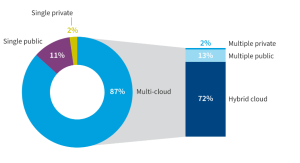
As businesses try to make software deployment and management easier between various computing environments, multicloud adoption is becoming more widespread. According to Forbes experts, approximately 90% of leading enterprises have already embraced this approach. Flexera estimates the number as 87% (see the picture below).
Multicloud vs hybrid cloud
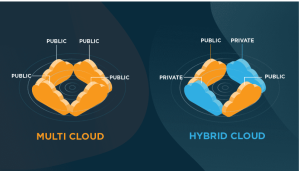
These two notions often emerge in similar contexts. However, you should keep in mind that these are separate concepts, with their own features.
Having difficulty distinguishing between them? Consider a hybrid vehicle that incorporates two distinct types of engines – an electric one and a conventional combustion one – to propel your transportation. In contrast, for the multicloud option, visualize employing an array of various transportation modes to reach various destinations. You might head for a shopping center in your automobile, but opt to take the subway to your workplace instead.
The interpretation of both concepts can fluctuate depending on the in-house processes, infrastructure, and procedures of a particular firm, resulting in discrepancies and bewilderment. Nonetheless, comprehending that these two expressions connote dissimilar concepts and are not interchangeable is crucial.
Main reasons why businesses embrace multicloud services
Enterprises opt for a multicloud strategy primarily to facilitate seamless data transfer between distinct public cloud services or to leverage the most suitable platforms offered by numerous IT companies.
Greater portability
Many companies embrace this approach in an attempt to avoid vendor lock-in. By resorting to various providers, businesses can easily move their data or digital product from one platform to another, giving them more bargaining power in cost negotiations. However, this may require building solutions that are more generic and do not take full advantage of proprietary features and services, which can result in subpar performance.
Also, adopting a multicloud strategy can furnish supplementary benefits, including failover plans that safeguard against cloud failures and offer coverage in regions where the principal cloud provider may not operate. This can be especially crucial for enterprises that necessitate uninterrupted access to their data or serve a worldwide clientele.
Possible expansion
Another cause of going multicloud is to obtain additional features not available on just one platform. By strategically integrating multiple cloud environments, you can optimize your software and gain competitive advantages. However, this comes at a cost, both in terms of additional expenses and more complex management requirements. It’s important to approach this strategy with full awareness of the tradeoffs involved.
With the right team in place to oversee the process, a well-executed multicloud approach can lead to substantial advantages in the long term. By leveraging the strengths of multicloud platforms, you can build a more resilient and efficient system that delivers greater ROI on your cloud investments over time.
Key benefits of the multicloud approach
By utilizing multicloud technology, organizations can unlock a variety of advantages that boost software performance. Below are the most important ones:
- Leveraging the top-notch options
Adopting multicloud platforms empowers organizations to cherry-pick the finest services, enhancing the performance of their digital products to a considerable extent. While making a choice, businesses can evaluate a variety of factors like pace, trustworthiness, location, and regulatory requirements to capitalize on the strengths of every cloud vendor. This enables enterprises to optimize their cloud usage and benefit from the unique features and capabilities provided by each supplier.
- Preventing supplier dependency
Choosing a multicloud architecture facilitates prompt and unrestrained infrastructure deployment. Thus, companies evade vendor lock-in and select the platform that perfectly meets their business needs. This approach mitigates concerns regarding data, interoperability, and costs that frequently emerge when excessively relying on a single cloud provider.
- Value for money
Utilizing multicloud platforms is a viable solution for reducing your IT expenditure. Public cloud services entail reduced overheads while simultaneously enabling scalable customization in accordance with your specific requirements. You can minimize total cost of ownership while leveraging the optimal combination of pricing and functionality from different IT providers.
- Pioneering innovations
Market leaders are always making significant investments in creating and releasing new and innovative products and services. One of the multicloud benefits is the ability to leverage the latest technological advancements as they become available, enhancing your own operations without being restricted to the services offered by a single company.
- Improved security and strict compliance
One more benefit of multi cloud platforms is that they allow for centralized management of security and compliance policies, simplifying the implementation of security measures and reducing the risk of vulnerabilities. This can be especially important for businesses operating in highly regulated industries, as it ensures that all workloads are consistently meeting compliance standards across different cloud providers.
- Enhanced dependability
By opting for this approach, you can avoid unforeseen downtime or disruptions and eliminate the possibility of a single point of failure. If there is an outage in one cloud, others are not necessarily affected. If a cloud service becomes unavailable, computing resources can be redirected to another cloud that is fully functional, ensuring uninterrupted service.
Multicloud-related challenges
Although the benefits of multicloud platforms are numerous, this approach is not without its challenges. Organizational issues with multicloud may involve difficulty in management, security continuity, linking up software environments, and making sure the many clouds function well together.
To ensure a successful migration to a multicloud environment, it is critical to establish a step-by-step strategy and roadmap. This entails understanding the motives for moving to a multicloud setup, defining measurable objectives to be accomplished, and outlining a long-term vision for the migration. With a solid strategy in place, organizations can effectively analyze their internal operations, select the optimal cloud environment, and choose the appropriate architecture, tools, and network configurations to achieve their goals.
Current multicloud trends worth attention
Currently, the focus is shifting away from the initial adoption of multi-cloud environments to areas such as controlling costs, ensuring security, matching the appropriate applications with cloud services, and continued growth.
A further expansion of hybrid infrastructure and the prevalence of multi-cloud deployments
In 2023, the use of innovative cloud approaches is predicted to grow, as more businesses embark on digital transformation. This approach fosters innovation and delivers benefits such as failover support, disaster recovery, freedom from vendor lock-in, and PAYG models. Hybrid cloud models can incorporate various combinations of on-premises resources, private clouds, and multiple public clouds, giving organizations greater control over data storage. In 2022, experts found out that approximately 37% of enterprises are spending over $12 million annually on cloud computing.
Embracing modern cloud strategies without proper planning and due diligence can result in complex dependencies and architectural designs for many organizations. A hasty adoption of services can lead to a lack of strategic planning and compromise the success of a long-term enterprise.
As a result, more companies are expected to take a break and reconsider their cloud strategies, ensuring they are aligned with their primary objectives to avoid any potential challenges .and also facilitates DevOps development methodologies and platform engineering, allowing enterprises to enhance their flexibility and expandability. For more on this, make sure to check out Duplocloud’s guide.
Reasonable cost management
The sudden shift to remote work caused a spike in the adoption of cloud infrastructure, making multi-cloud platforms a crucial tool for IT leaders to manage remote access to their assets. While multi-cloud offers many benefits, CIOs are also grappling with the challenges of cost management, as expenses associated with private, public, hybrid, and multi-cloud environments continue to rise. Companies are having difficulty predicting their cloud spending precisely and managing costs, requiring them to make cost optimization a priority in their multi-cloud strategy.
Businesses must keep tabs on and investigate the utilization and features of various cloud suppliers in their multi-cloud and hybrid cloud settings to secure cost-effectiveness in the usage of cloud services. Having a thorough understanding of cloud usage can help enterprises make wise decisions about which services to retain, enhance, or remove from their budget. Different providers have different pricing, like a set price or extra fees dependent on usage and the type of service. Companies may look into transferring some of their workloads to public clouds as a way to reduce their costs. Be mindful when transferring data between clouds, as you may be charged high egress fees, resulting in an expensive vendor lock-in. It is projected that more businesses will start more proactive and intense conversations with cloud suppliers in 2023, in order to discover cost-saving methods, as they attempt to find the perfect equilibrium between multi-cloud advantages and the cost of cloud adoption.
The striking popularity of Microsoft Azure and Google Cloud
These providers have made great strides in challenging AWS’s long-standing leadership. In 2022, the usage of Azure matched that of AWS for public cloud adoption, where 76% of companies are now employing AWS, and the same percentage applies to Azure. In comparison, Google Cloud is trailing its rivals with only a 48% acceptance rate. Oracle Infrastructure also had growth in 2022, with an adoption rate of 28%, while IBM Public Cloud had an adoption rate of 25%. As the market landscape changes, it will be interesting to see how the cloud providers adapt and respond to these challenges.
Emphasis on enhanced security
Adding more vendors can bolster security by offering alternate systems in case of an attack. Numerous companies that rely on multiple cloud platforms are inclined to use the built-in and native security tools to guarantee safety. To protect their customers, cloud providers are investing more in their security, such as Microsoft putting in over a billion dollars a year and Google purchasing third-party security providers like Actifio. Multi-cloud environments are becoming more commonplace, causing CSPM to become increasingly popular to handle governance and compliance. Even the most minor misconfigurations can result in security issues, particularly in public cloud systems.
Conclusion
Multicloud platforms give businesses unprecedented flexibility and boost the performance of their software solutions. This is essential for success in today’s rapidly digitizing business environment. By embracing innovations, you are getting better adaptability, scalability, and enhanced security mechanisms.
Partnership with a reliable сross-platform app development company offering versatile services including those related to the cloud is the key to success. So, to ensure that your business gets the maximum value, find the right IT experts who will advise you on how to implement this approach in practice. By reaping the benefits of multicloud environment, you will achieve greater business success.