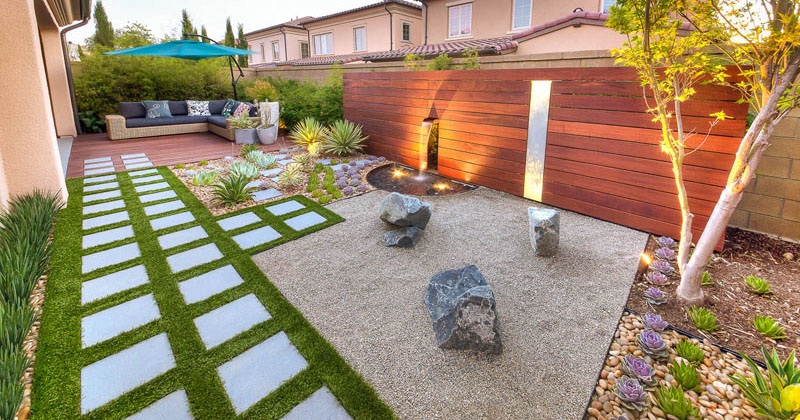
A Japanese Zen garden is a place where calm takes shape, and every component earns its place.
The careful placement of the plants, sand, and stones gives the area a smooth, intentional feel. It’s a setting that speaks softly yet leaves a lasting impression, encouraging you to slow down.
Creating one is as much about shaping the mind as it is about shaping the land.
Understanding the Spirit of a Zen Garden
A Japanese Zen garden is a carefully balanced composition where natural form meets precise arrangement. Its purpose is to distil the wider landscape into a space that promotes stillness and focus, using only a small selection of elements.
The surface is prepared with a compacted base, often of crushed stone or granite, to ensure long-term stability and proper drainage.
Weathered rocks are set with great attention to their shape, angle, and proportion, and fine gravel or sand is spread evenly to form the canvas for raked designs that suggest the movement of water or the passage of wind.
Planting is also sparse, chosen for its resilience and texture as much as its aesthetic appeal.
Moss thrives in shaded, moist conditions and brings a velvety softness to the ground plane, while a Japanese maple offers seasonal change without disrupting the garden’s calm structure.
Stones are arranged in asymmetrical groupings, typically in odd numbers, with careful spacing to allow negative space to play an equal role in the design.
Beyond visual appeal, each element has meaning. Rocks may symbolise islands, mountains, or points of stillness, while the gravel’s rippled lines can suggest rivers, shorelines, or open sea.
This symbolic framework, developed and refined over centuries, allows the garden to be read like a visual poem, where every detail is intentional and every absence just as important as what is present.
Drawing Inspiration from Tradition and Experience
Before shaping your Zen garden, it’s worth immersing yourself in its traditions.
Books, museum collections, and trusted online sources can reveal the principles behind its enduring appeal.
Yet nothing matches the insight gained from visiting existing gardens, where the scale, textures, and flow can be experienced firsthand.
When you walk through a well-crafted Zen garden, you notice more than the arrangement of stones—you feel the shift in atmosphere.
The sound of your steps on gravel, the way the light plays on a mossy surface, and the framing of a single tree against a wall all contribute to the mood.
Conversations with experienced designers or time spent at a Zen retreat can uncover subtleties that transform a simple plan into something truly evocative.
As the saying goes, the proof of the pudding’s in the eating—and seeing a Zen garden in person is the surest way to understand its magic.
Selecting the Perfect Setting
A Zen garden thrives in a location that feels naturally peaceful, away from traffic hum or constant chatter.
This can be a sheltered courtyard, a quiet corner of a larger garden, or even an unused area that can be transformed into a contemplative retreat.
Sunlight patterns should be considered for plant health, and good drainage is essential to prevent standing water.
Equally important is the relationship between the garden and its surroundings. A view from indoors can turn an ordinary room into a place of calm focus, while a wall or fence can act as a protective backdrop.
Before starting construction, marking out the intended boundaries allows you to visualise how the garden will sit within the wider setting.
By carefully planning, you can avoid having a beautiful garden that appears out of place in its environment.
Designing with Flow and Intention
When planning the layout, aim for a structure that feels unforced, with gentle curves and irregular shapes that echo nature.
Open gravel areas give the composition breathing space, while focal points such as rocks or plants guide the gaze. Sketching the arrangement or using digital tools can help refine proportions before any work begins.
At this stage, it’s also worth considering how the design aligns with broader landscape design principles, ensuring the garden integrates gracefully with the rest of the property.
The way pathways direct movement, the balance between open and planted areas, and the relationship between foreground and background views all contribute to the overall harmony.
Even subtle features, like the placement of a lantern or the height of a planting bed, can influence how the garden feels when walked through.
Choosing Materials and Key Elements
Authenticity begins with natural materials that age gracefully, such as locally sourced stone, fine gravel, and untreated timber.
Combining smooth river stones with textured rock adds contrast, while varied gravel shades bring depth to raked patterns. The placement of rocks, often representing mountains or islands, sets the tone for the entire composition.
Moreover, gravel or sand serves as a canvas for raked lines, which can be refreshed as a meditative ritual. The act of raking itself is part of the garden’s appeal, a mindful practice that turns upkeep into reflection.
Plants like moss, bamboo, and dwarf pines add greenery without overwhelming the design, while discreet water features such as a stone basin or bamboo spout introduce gentle sound without disturbing the minimalist feel.
For best effect, every component should feel as though it’s always belonged there.
Maintaining a Living Work of Art
A Zen garden’s charm comes from its ongoing care, which can be as meditative as the space itself.
Regularly removing leaves, managing weeds, and re-raking gravel patterns keeps the garden looking fresh and serene.
These simple tasks encourage a rhythm of observation and adjustment, allowing the garden to evolve naturally while preserving its essence.
Beyond daily tidying, seasonal maintenance plays an important role. In spring, lightly top up gravel to maintain crisp edges on raked lines.
Summer calls for more frequent watering of moss or shade-loving plants, while autumn brings the need for gentle sweeping to prevent decaying leaves from staining the gravel.
In addition, winter care means inspecting stone placements for frost movement and ensuring drainage channels remain clear.
Over time, subtle changes in light, shadow, and growth may inspire small refinements. A patch of moss typically spreads beyond expectation, a rock’s weathering deepens its character, and a new planting subtly shifts the balance.
These modifications are part of its ongoing story, not interruptions, and treating them as opportunities for improvement keeps the garden alive in both spirit and form.
Conclusion
You’ve brought together patience, skill, and a clear eye for beauty to create something genuinely remarkable.
Each detail reflects thought and care, resulting in a garden that offers peace in every season. It now stands as your refuge, a space that quietly restores what the day may take away.
Treasure it, for it will only grow richer with time.