Source: from CareerFoundry
As a UX designer, you are likely to attend interviews during your job search. For full-time employees and freelancers alike, the recruitment decision is often made based on a personal talk with an HR manager. So, you need to be ready for such interviews, both professionally and psychologically, to succeed in self-presentation. The way you behave, showing your positives in work and mindset, will affect your salary and work conditions. Thus, we recommend taking this preparation seriously.
To help you out, we have prepared a handy list of designer interview questions that every second UX specialist faces. Read them through and conduct a self-check to see how prepared you are for the next meeting with a recruiter.
Top 10 UX Designer Interview Questions
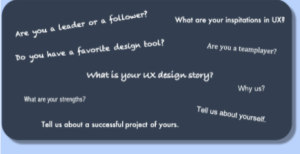
UX is a diverse area of web design that requires in-depth knowledge and practical expertise from a designer. Thus, a recruiter’s task is to test that expertise and evaluate the candidate’s suitability. They typically achieve this goal by asking the following questions.
Source: from Ramotion
#1 What is UX design?
This is typically one of the first questions with which the interviewer begins your meeting (after a mutual introduction). At this point, you shouldn’t provide a dictionary definition for UX. Instead, focus on the role of UX in the broader project design process. Tell about your vision of UX’s contribution to project success and share your view of how UX creates value. In this way, you will show how you see your place in the company and web design team.
#2 Name some examples of good UX
It’s not about your personal preferences; the question is much deeper in meaning. The recruiter is likely to test your comprehension of good UX elements. Thus, when you name a project or two, be ready to explain what makes you think it’s good in terms of UX. Bridge theory and practice of UX design by illustrating how good UX assumptions work in real-life applications.
#3 What is the UX/UI distinction?
Though the difference is subtle and often unclear, you should understand it as a UX specialist. That’s vital to avoid role conflict and ambiguity in the process of project design. Thus, your task at this phase of the interview is to explain that UX is about the product’s practical work while UI is more about its good looks. It may also be relevant to refer to your past experience working with UI designers and explaining how you divided project work.
#4 What are the steps of your workflow?
At this point, the recruiter might be testing your approach to problem-solving. So, here you need to explain how you break down the design process and what data you use as guidance in decision-making. Be specific, as it’s an important aspect of your expertise evaluation.
#5 How do you conduct UX research?
UX design is impossible without research. So, you need to show that you’re well-versed with research methods and know how they differ. Talk about various methods you’ve already applied and how you chose from the list of options. Give some detailed analysis of research methods suitable for your recruiting company’s projects.
#6 How do you deal with positive and negative feedback?
Accepting rewards is easy, but taking criticism constructively is a real challenge for many people. UX is a collaborative process and a part of larger web product design, so you’re sure to meet criticism and deal with differing viewpoints. When answering this question, make sure you give enough details proving your ability to become a part of a team and explain different scenarios of feedback incorporation.
#7 What UX project are you proud of?
Again, it’s more than a talk with a friend, and the project’s name will not be enough. You need to explain why you pick this or that project as your biggest achievement, thus disclosing your weak and strong sides in UX design. Be ready to answer follow-up questions on these points.
#8 Why did you choose UX design as your career?
Career choices also represent much interest for recruiters as they want to be sure that their staff is committed and stable. Companies don’t like hiring experts who leave in a year or two because of a sudden wish to try something new. So, here you’re expected to talk about your professional interest and passion for UX.
#9 What are your challenges in UX design?
Acknowledging your weaknesses is very important. Nobody is ideal; the difference is only in the attitude to your weak sides. Don’t be afraid to recognize your gaps, but also make sure you mention a desire to learn and improve your expertise.
#10 Where do you see yourself in 5 years?
This question relates to your sustainability as a staff member. Thus, your task is to show how dedicated you are to personal and professional growth within the UX industry.
Source: from Robert Half

Getting Ready for the Interview to Maximize your Chances
Even knowing the answers to questions we’ve just discussed is not a guarantee of success. You can spoil the first impression if you present yourself incorrectly, thus overshadowing all your competencies and skills. To avoid this problem, use our tips enumerated below:
- Work through your initial self-presentation to produce a positive impression on the recruiter. Your pitch should be memorable and original.
- Learn as much about the target company as you can. You need to prove that you are the best match for the open vacancy, which is impossible without profound knowledge about the brand, its mission, and critical projects.
- Know your interviewer by name. A personal touch in face-to-face communication matters much.
- Produce a positive impression by tidying your room and looking neat and prepared. There’s nothing worse than joining a call in a pyjama and with a background mess.
- Stay relevant to the topic and questions. Don’t go at length when talking about yourself.
- Don’t get confused if you don’t know some things or answers. It’s natural to have knowledge gaps.
- Talk to the interviewer honestly and optimistically, without sounding judgmental or critical about your previous employer.
If you follow these tips, your chances for successful employment rise manifold. HR specialists often look beyond a resume and portfolio, hiring people who can seamlessly integrate into the team and deliver professional and personal value. Good luck!