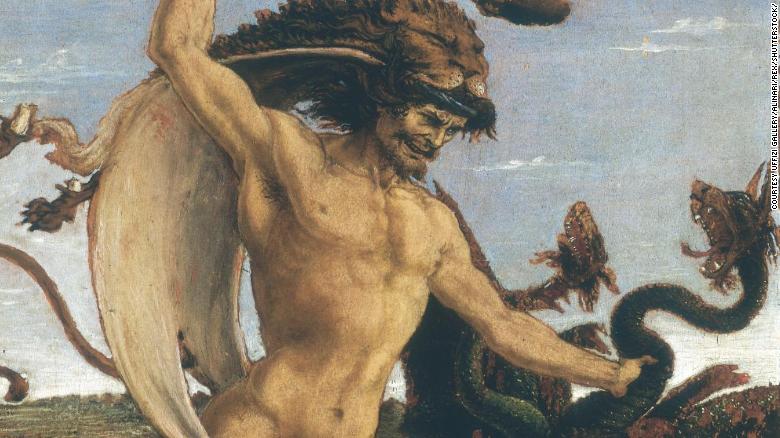
Greek goddess paintings have always been a point of great attraction for artists. The Christian characters and their symbolism sonorously are spread through these mythology paintings.
From ancient Greek paintings to modern-day Greek classics, a wide range of mythology paintings intrigues us. Renowned artists have always relished this genre, and their paintings leave you nothing but to believe such scenes might have existed.
Hence, to learn more about such scenic beauties and the most famous Greek mythology paintings, keep reading the segment below. In addition, we have put forth a list of the most stunning pieces of Greek goddesses all across the globe.
The Birth Of Venus By Sandro Botticelli
Sandro Botticelli created The Birth of Venus in the year 1482. He is a well-known artist from the Renaissance period who usually concentrated on Christian characters in his greek renaissance paintings. The Medici Family has primarily requested the painting.
Many of Botticelli’s paintings are inspired by the Greek goddess, and this one is the best example of it. It is considered the most elegant and charming work of Botticelli.
Goddess Venus is vividly depicted at the center of the canvas. In Greek mythology, she is popularly known as Aphrodite, the goddess of beauty, love, and procreation. There are other Greco-Roman deities on either side.
Leda and Swan By Peter Paul Rubens
An artist like no other, Peter Paul Rubens painted this iconic eye delight in 1600. It is an oil on canvas currently kept at the Collection of Museum of Fine Arts, Houston.
It is the picture-perfect example of a Greek goddess painting in which women are considered divine beings. They were often used to enhance the sensual element of the portraiture with their beauty and physique.
In Leda and Swan Rubens, the swan touches Leda on her most secret spot. Her neck is cupped between her breasts while she is represented naked. The swan symbolizes an elegant creature with the ability to ravish.
The Fall Of Phaeton By Peter Paul Rubens
Another fantastic piece of Greek creation by Paul Rubens is The Fall of Phaeton. The mythological painting showcases the ancient Greek story of Phaeton. It is a frequent motif in visual arts and was painted by Rubens in 1605.
Phaeton was the son of Helios and Clymene. Helios was eventually given command of the chariot. However, he approached the Earth too closely due to his inability to control the horses.
Consequently, Zeus knocked him down with a bolt to avert a calamity, and because of this, Phaeton died. The creation is held captive by Rubens due to the sheer addition of dramatic moments in the painting. Superficially, at the time when Zeus’ thunderbolts slam into Phaeton’s chariot.
Sleeping Venus by Artemisia Gentileschi
Gentileschi completed the enigmatic oil painting Sleeping Venus in the year 1630. This exceptional piece of art is immensely impacted by the artist’s father’s techniques and Michelangelo Merisi da Caravaggio (renowned partner).
It is a painting highly distinguished from others by the dramatic juxtaposition of light and dark and distinctive, striking compositions. It is an excellent depiction of Venus, dozing beneath a velvet drape.
The bedcovers are colored with shades of expensive ultramarine derived from crushed lapis lazuli. Behind her is Cupid, who carries a peacock-feather fan.
It is used to deter bugs from bothering or awakening her. On the left is hilly terrain with a little round temple. It is evocatively devoted to Venus near Hadrian’s home in Tivoli, which lies outside Rome.
Oedipus and the Sphinx by Gustave Moreau
Competed in the year 1864, Oedipus and the Sphinx by Gustave Moreau is a fabled meeting between the two mythological characters. They were on the route to Delphi, famously depicted in Sophocles’ play Oedipus Rex.
Oedipus found that the king, Laius, was later murdered. Also, the kingdom was at the whim of the Sphinx during his trek between Delphi and Thebes. Furthermore, the narratives of the painting entail that the Sphinx sacrificed herself by hurling herself into the sea.
Oedipus solved it correctly and then became the new king. On the contrary, Moreau celebrated a purposely antique painting technique focusing on the aspects of realism of the mid-19th century. The bottom line concluded it speaks that the Sphinx is on the attack in the piece and clutching at Oedipus.
The Lament For Icarus by Herbert James Draper
The famous work of art is said to have been produced around 1898. It is near the close of a period in which the painter focused more on painting scenes from Greek mythology.
Mostly, the well-known paintings depicting Icarus’s story focus on the instant of his fall. But, the phenomenal artist Draper illustrated the period following Icarus’ death. Nymphs surround Icarus in the very painting.
The Lament For Icarus is considered one of his most notable works. Inspired by Greek mythology art, it is a painting worth knowing about.
The Bottom Line
Every Greek goddess painting coming from the mythological era has its own story. Every character, technique, and narration puts light on the centuries-old artwork. These are rare to find paintings in the modern world. So many art galleries sell these oil on canvas reproductions for the same. You can avail of it online at these cost-effective prices.